
Sub-Total: $0.00
Range Ready: A Successful Guide to Introducing New Firearm Owners to Their First Range Experience with Confidence and Success
Tags:
A Successful Guide to Introducing New Firearm Owners to Their First Range Experience with Confidence and Success
BY HEIDI LYN RAO
The sights, sounds, and smells of a gun range may be something that brings comfort to you as a frequent and experienced shooter. To a brand-new shooter, a trip to the gun range may be intimidating because they are entering into unfamiliar territory. I am fortunate to spend a lot of time at the range. As a certified NRA Training Counselor, I teach handgun, rifle, and shotgun classes each week as well as offer private lessons. I have the opportunity to meet a wide variety of individuals. Many are recreational or competition shooters, but I am encountering more first-time gun owners now than ever before. These individuals, often from non-shooting backgrounds, are eager to get to the range with their new investment. Oftentimes, they seek guidance from a reputable and trained instructor to show them the proper way to handle their firearm safely and how to be successful hitting the target.
Whether you are a certified firearms instructor or someone who invites a new shooter to join them on the range, there are several things that should be taken into consideration. How we introduce someone to a shooting range will set the tone for their experience. We hope the experience is positive not only for you but also for the new shooter who accompanies you. Your goal should be to offer a fun, educational, and safe experience. The first things you must consider are the location you will visit, the gear you will bring, and other items needed to ensure a safe and comfortable environment. As shooters and hunters, we must remember that a new firearm owner does not have the same comfort level, history, or experience around firearms as we do. We must come to their level, meeting them where they are, and introduce them to the 5 fundamentals of shooting.
There are pros and cons for each type of range, indoor versus outdoor. Most shooters, depending on their location, have an option to choose their preference of indoor or outdoor ranges. This means a new shooter can find the type of facility that meets their needs and that they feel comfortable visiting. Each type of range has its own distinctive characteristics, features, advantages, and disadvantages.
INDOOR SHOOTING RANGES
Indoor ranges can be very comfortable in a climate-controlled environment, keeping everyone cool in the heat of summer and warm in the cold of winter. It is a nice place to enjoy shooting and stay dry when it is raining outside or the weather is just not cooperating. Another advantage is having constant lighting conditions. Many ranges have programmable target carriers so the shooter can set his or her own distances to shoot, all from the comfort of staying in one place. Most indoor ranges have individual shooting lanes, so a shooter has his or her own space, usually with a wall or divider on either side of their “table” to compartmentalize.
their private shooting area. Another added benefit is many indoor ranges have a full-time gunsmith on staff, available to assist shooters with any issues they may have with their firearm or answer any questions on-site. Additionally, many indoor ranges offer rental guns to customers.
On the other hand, indoor ranges generally have more restrictions on what firearms you can shoot at their location. Large caliber rifles are generally not allowed due to the risk of damage to the down-range infrastructure. Long-range rifle shooting is difficult in an indoor range due to space and limitations by the construction of the facility. The largest indoor range I have visited is a 100-yard range, so the needs of many long-range rifle shooters cannot be met.
The most common type of firearms that are used at indoor ranges are handguns. Shooters are assigned to a specific booth and a shooting lane. Most ranges limit shooters to their confined area, which restricts movement. Due to the indoor acoustics, these ranges are often very loud due to the number of people who may be there, all shooting their firearm at the same time. This can be quite distracting for a brand-new shooter with the increased noise and activity in a confined space. This environment can make it difficult to teach a new shooter and to help ease any anxiety he or she may have.
OUTDOOR SHOOTING RANGES
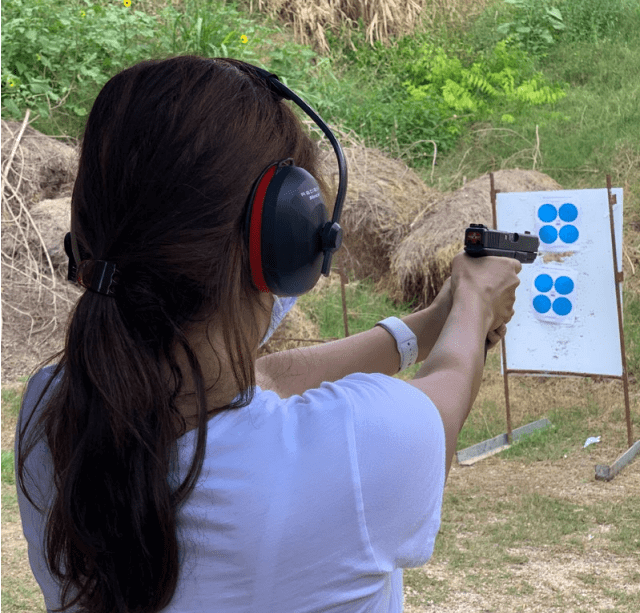
Outdoor ranges normally give you more capability and flexibility to train with any type of firearm, depending on the limitations of the range. There are more opportunities for shotgun enthusiasts, including the games of trap, skeet, 5-stand, and sporting clays. Some ranges even allow for shoot-and-move drills like transitioning between targets. Outdoor ranges generally have targets set at much longer distances, some up to 600 yards or more, for long-range rifle shooters. The outdoor environment can sometimes make it easier for someone to teach a new shooter, with fewer distractions from others from the public who may be there, because there is more space to spread out with a bit of reduction in noise.
On the other hand, outdoor ranges are subjected to the weather. Even though environmental factors may not affect or concern you, always be ready to keep your new shooter safe and comfortable when conditions change. If it is hot or rainy, you should plan to have a canopy for shade and to stay dry. Always keep an ice chest filled with ice and water, and electrolyte-replenishing fluids for hydration. If it is cold, have extra layers, scarves, gloves, or handwarmers to offer your invitees a more pleasant experience.
Upon the command “Cease Fire,” you will either have to walk down range to change targets or wait for the Range Safety Officer (RSO) to change targets, depending on the rules of the range. Then, when it is safe and everyone has returned to the shooting area, the “Range is Hot” command allows for shooting once again. This generally takes a bit of time to change targets, depending on how many shooters are also on the line with you and how far down-range the targets are placed. By removing as many distractions as possible, both real and perceived, and keeping them comfortable, your new shooter will be able to better focus on your instruction, guidance, and proper shooting fundamentals for success on target.
COMFORTABLE ENVIRONMENT
As an NRA Training Counselor, I know that a trip to the shooting range can be overwhelming and intimidating to a new gun owner. I see it all the time. Whether you are a certified Firearms Instructor or someone who has invited a friend or family member to join you for a day at the range, it is our job to welcome these first-timers and inexperienced shooters to a safe and pleasant range experience, so they keep coming back.
Remember, these new gun owners are participating in an activity they are not used to doing and traveling to a place they have never encountered. Having some basic comfort items like cold water, a few snacks, and a restroom close by can increase the comfort level of your guest. Don’t forget to ask your new shooter what they hope to walk away with after your session on the range. Regardless of the number of new shooters you have with you, if only one or a small group, chances are they are all interested in learning the basics, feeling comfortable, increasing confidence, and hitting the target with their new gun.
ESSENTIAL GEAR
Although a new shooter may have their firearm and matching ammunition for their day on the range, they may not have other required and necessary safety items. As their mentor, it is our job to supply the essential equipment or direct them to where they can purchase these items for an enjoyable outing.
Ear and eye protection are a priority. I always keep a supply of foam earplugs and over-the-ear muffs for hearing protection when I am working with a new shooter. If their gun is louder than they expected it to be, or if you are at an indoor range where noise is at a high level, your new shooter has the option of doubling up with foam plugs and ear muffs on top. Additionally, I always keep extra pairs of shooting glasses in my range bag for new shooters. A new shooter will frequently show up to the range with inadequate eye protection. It is also a good idea to have eye protection with interchangeable colored lenses to account for the lighting conditions where you are shooting. For example, orange lenses work great on a shotgun field, yellow lenses work best at an indoor range with dim lighting.
I always provide a variety of firearms and matching ammunition for the new shooter to try. Many times, a new gun owner was urged to purchase the firearm that the employee behind the gun counter prefers or was advised by a friend or family member to buy their favorite brand or caliber. Often, this particular firearm does not “fit” the new shooter, whether the grip is too large or too small, or the caliber does not match the intended reason for owning the new gun.
STARTING WITH THE BASICS
The very first thing you should do with a new shooter is an eye dominance test. A quick way to determine eye dominance is to face one another with several feet in between. As the mentor, have your student keep both eyes open and raise one hand up to point at your nose. Next, have them lower their hand while keeping both eyes open, raise their other hand, and point at your nose again. Their pointed finger will naturally fall below their dominant eye, and you can quickly determine which it is. You can also test yourself by standing several feet away from a mirror. While keeping both eyes open, point at your own nose to see which eye your finger naturally points beneath. Regardless of which is our dominant hand, we should always shoot under our dominant eye. This means for handguns, shooting with the same hand of your dominant eye. For shotguns and rifles, this means shooting from the shoulder under your dominant eye.
One of the biggest issues with shooters, both beginners and advanced, is they are shooting their firearm under their non-dominant eye. Although it may feel awkward at first if you are right-handed and left-eye dominant, or left-handed and right-eye dominant (otherwise known as “cross-dominant”), you will be amazed at how much your marksmanship improves and how quickly you become a better shooter. You will never shoot as good as you can until you shoot from the hand under your dominant eye. Always start a new shooter with an eye dominance test so they have a platform for successful shooting from the beginning.
Always use a blank target or a target with a single dot placed in the center to build confidence. There is something about a bullseye target or a busy target that is intimidating and extremely distracting to a new shooter. Start with a close target as well. By focusing on targets 3 to 7 yards, the shooter can hone his or her skills to master that distance. A close target usually is accompanied by success. There is a saying, “Aim small, Miss small.”
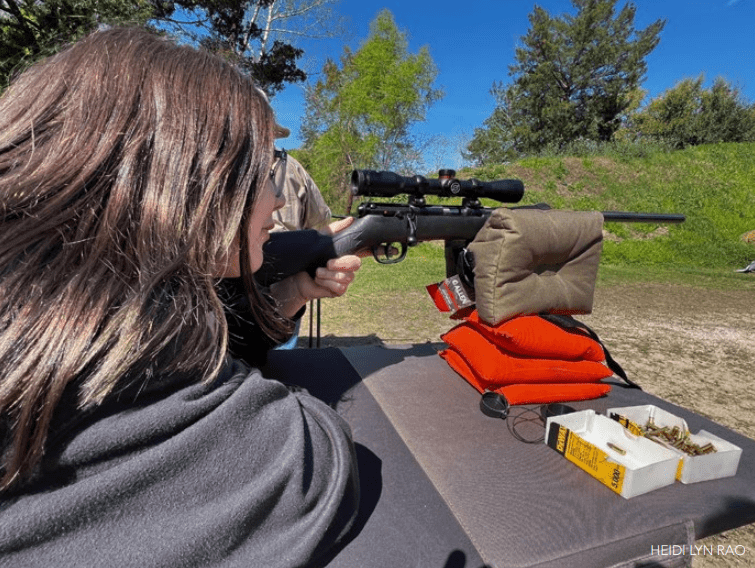
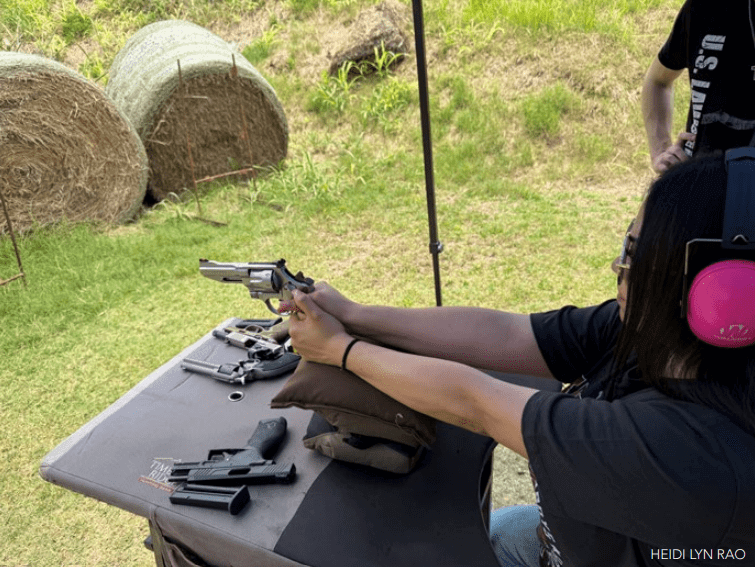
We can avoid establishing bad habits with a new shooter, such as flinching, anticipating recoil, and closing their eyes when they shoot. When teaching someone the five fundamentals of pistol and rifle shooting, it is advised to start with a .22 caliber firearm for several reasons. There is little to no recoil and very low noise. This allows the instructor to focus on the five fundamentals of shooting without the distraction of a larger caliber firearm. As a Firearms Instructor, I start a new shooter with a single-action .22 revolver in the pistol class and a bolt-action .22 in the rifle class. I can slow the students down so they can concentrate on each one of the steps as a separate action, so they can experience each fundamental as they perform it.
Once the new shooter is comfortable with each of the shooting fundamentals and gains confidence on target, a different firearm can be introduced, even a larger caliber. Once they are successful on target using a .22 and practicing the fundamentals of shooting, these same steps can be applied to any firearm they shoot. You will quickly watch their confidence soar when they can successfully shoot their own, brand-new firearm, and consistently hit the target where they aim!
THE 5 FUNDAMENTALS OF PISTOL AND RIFLE SHOOTING
It is essential that all shooters understand what each of these fundamentals are and what they mean for success at the target: Aiming, Breath Control, Hold Control, Trigger Control, and Follow Through.
Aiming
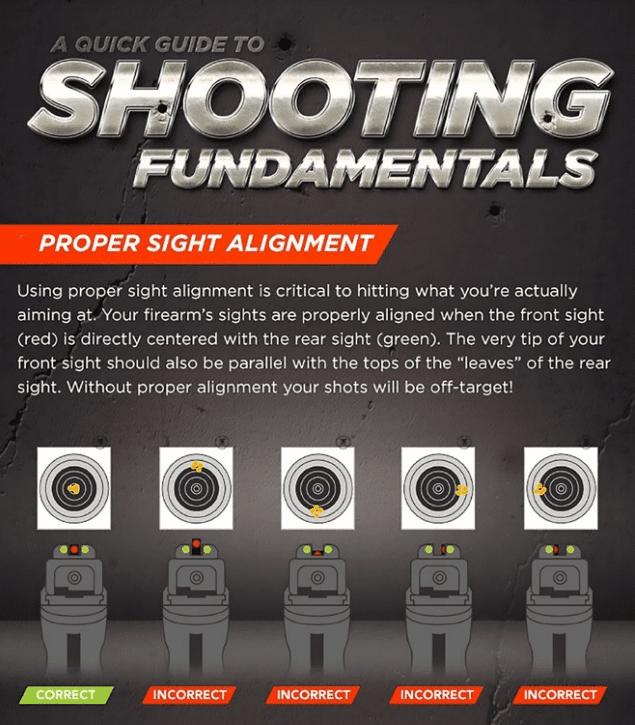
Proper aiming consists of sight alignment and sight picture. To obtain a proper sight alignment with iron sights, the front sight or post is centered and positioned inside the rear sight. The top of the post should be even with the top of the rear sight. You will notice that the front sight does not completely fill in the rear sight. This is why the front sight must be centered in the rear sight so there is equal space on either side of the front post. The easiest way to remember where the front sight goes in the rear sight is – Equal Light (on either side), and Equal Height (across the top).
After you acquire the proper sight alignment, you must acquire a proper sight picture. First, to acquire the proper sight picture, you must know what to focus on. Since your eyes can only focus on one thing at a time, always focus on the front sight. The shooter should keep both eyes open. This reduces eye strain and allows the shooter to maintain depth perception. That means everything else in your sight picture will be slightly out of focus.
Breath Control
Because we are living and breathing beings with a heartbeat, we are always in motion. Your breathing can move the firearm just enough to throw off your shot. When shooting, take in a deep breath and exhale. Some shooters exhale approximately half of their breath, then hold it, and take their shot. It is important to pause your breathing when the shot is taken. Once you fire and while following the other four fundamentals, take another breath, repeat the method, and then shoot again.
Sometimes, a new shooter takes too long to shoot after holding their breath. This is when muscle tremors start and movement increases. If you notice your new shooter doing this, have them take their finger off the trigger, relax, reset, and start the process over again.
Hold Control
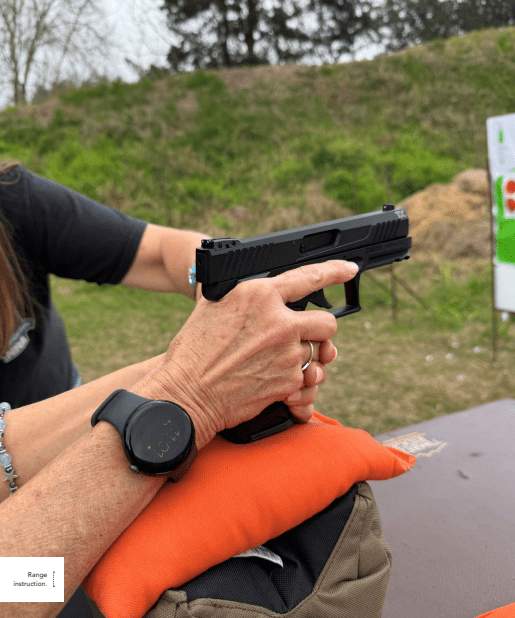
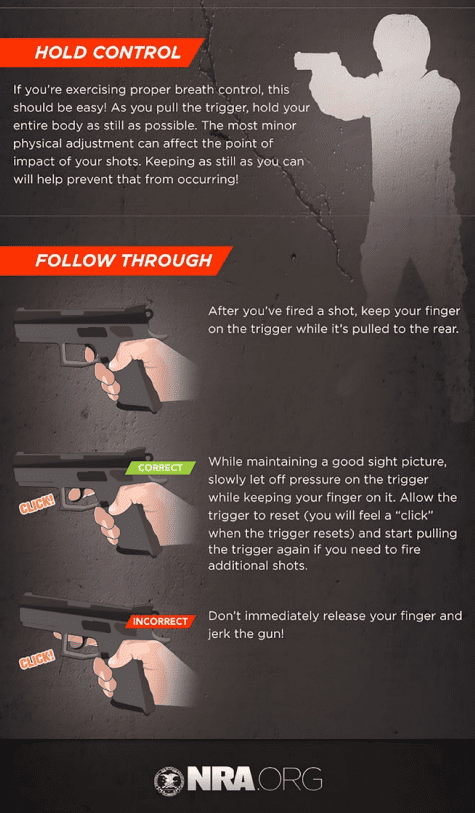
Hold control can be challenging for a new shooter. The handgun needs to be held firmly, but not too firm, just tight enough to control the gun. A grip that is too tight will affect accuracy. The best way to describe the proper grip is that of a firm handshake.
The shooting hand (the hand that is under the dominant eye) needs to be placed high on the backstrap of a pistol, but not too high as to interfere with the slide. Revolvers also need to be held high on the backstrap, but not too high as to interfere with the hammer when it is cocked. The fingers on the shooting hand need to wrap around the grip and the front strap.
The support hand should cup the bottom of the grip and wrap around and over the fingers of the shooting hand. When using a revolver, the thumb of the support hand should rest on the thumb nail of the shooting hand. When using a semi-automatic…
I instruct my students to know their firearm well enough to know when it should discharge when the trigger is pressed. This is accomplished through practice – dry firing at home and live firing at the range.
After the firearm discharges, the shooter should slowly let off pressure and release the trigger so that it resets. If there is going to be a follow-up shot, the finger should remain on the trigger, and the shooter should begin the five shooting fundamentals once again. If there is not going to be a follow-up shot, the finger should be removed from the trigger guard and extended along the frame.
Follow Through
Follow-through is the continuation of the basic rifle and pistol fundamentals after the shot is fired. This is one of the hardest concepts to teach because it is the combination of all five fundamentals at the same time.
If you properly follow through on your shot, you must continue aiming while maintaining your breathing, hold, and trigger control. This allows the projectile to exit the barrel before the shooter starts moving the firearm. This also enables the shooter to fire follow-up shots if necessary. This is important if you want to be consistent in your marksmanship, shooting a timed course, learning self-defense, or hunting. Without proper follow through your accuracy will suffer, you may not get all your shots off in a timed event, or you increase the chance of wounding loss when hunting. I have seen many new shooters start to raise their head to see where their shot went as soon as they pull the trigger. You can actually see their gun start to move before the trigger is even pressed.
How long should you maintain your follow-through? It could be half a second, one second, two seconds, or however long it takes to set up for your next shot. The goal through practice is to improve your recovery time to be able to take follow-up shots, if necessary, quicker.
pistol, the thumb of the support hand should lay alongside and beneath the thumb of the shooting hand, parallel to the barrel.
Trigger Control
Trigger control is the method of moving the trigger until the firing pin or the striker of the firearm is activated and strikes the cartridge’s primer. This needs to be done while maintaining proper aiming, breathing, and hold control. The idea is to engage the trigger with as little movement as possible.
The shooting finger, usually the index finger, should be placed inside the trigger guard. The trigger should touch between the first joint and the fingertip. Slowly press the trigger while applying continuous steady pressure rearward until the gun fires.
Many shooters instruct by saying, “When the trigger is squeezed and the firearm discharges, it should surprise you.” I don’t know about you, but I do not want to be “surprised” by a firearm, and I do not want my students to be “surprised” either. Rather,
WHAT ARE YOU WAITING FOR?
Invite a new shooter to join you on your next range day soon! Take into consideration where you will teach them, indoors or outdoors, what gear you will provide for them, and how you will make their experience relaxing and comfortable. With the right introduction, their first shot will soon become a journey of self-confidence, enthusiasm, and responsible gun ownership, and they will eagerly await their next visit to the range!